| "Renewal
of prints through new technology continues to motivate my work."
Sue Gollifer List of Exhibitions 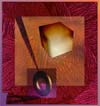 "My
work has developed in the last twenty years according to a rigorous programme
of formal experiment, through which sets of relationships evolved between
shapes, colours and tones. At first these relationships were concerned
only with the surface of the work: illusions of depth or movement were
made explicit as illusions, by using a systematic grid arrangement, and
maintaining the symmetry of the overall design. Later, perspective was
incorporated into the work, so that the arrangement could be read as a
depiction of a space with depth, although never as a 'scene ': the space
depicted exists solely in the work. "My
work has developed in the last twenty years according to a rigorous programme
of formal experiment, through which sets of relationships evolved between
shapes, colours and tones. At first these relationships were concerned
only with the surface of the work: illusions of depth or movement were
made explicit as illusions, by using a systematic grid arrangement, and
maintaining the symmetry of the overall design. Later, perspective was
incorporated into the work, so that the arrangement could be read as a
depiction of a space with depth, although never as a 'scene ': the space
depicted exists solely in the work.
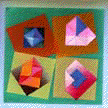
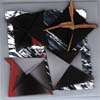
More recent prints are designed to raise questions about the surface itself. The prints are made of paper, coloured. If anything is represented on them it is coloured paper, with folds, angles and creases suggested, but at the same time contradicted by the arrangement of colours, lines, and tones. The intention, as always, is to provide an arena in which the eye can be stimulated and pleased, while the mind can exercise its right to pursue or to reject the illusions offered or withheld. 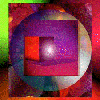 Each
print is of course a complete image, but when viewed in groups, or as a
series, the prints can be seen as stages in a continuously process of transformation,
from point to point, constantly polymorphic process, whose identity is
maintained by my preference of tonal, chromatic and formal combinations.
Although much of my work is still concerned with the traditional media
of printmaking, I have become increasingly involved with new reprographic
technology, using computer-generated imagery and innovative reproductive
techniques, such as laser-based scanning and printing. These assist me
to discover creative and surprising solutions to problems. The memory and
speed and the vast network of options allow new thought processes to be
explored and discarded painlessly as the ideas take shape, develop and
germinate. Each
print is of course a complete image, but when viewed in groups, or as a
series, the prints can be seen as stages in a continuously process of transformation,
from point to point, constantly polymorphic process, whose identity is
maintained by my preference of tonal, chromatic and formal combinations.
Although much of my work is still concerned with the traditional media
of printmaking, I have become increasingly involved with new reprographic
technology, using computer-generated imagery and innovative reproductive
techniques, such as laser-based scanning and printing. These assist me
to discover creative and surprising solutions to problems. The memory and
speed and the vast network of options allow new thought processes to be
explored and discarded painlessly as the ideas take shape, develop and
germinate.
 One
attraction of this new technology, of course, is the convenience: calculations
which once occupied hours, and involved painstaking measurement with ruler
and compass can be completed with greater accuracy in seconds, leaving
more time for the purely human judgments which remain fundamental to art.
Another, as I have suggested above, is the possibility of creative error:
a step taken with uncertainty can result in chaos, in which case it can
be quickly unmade; or, more rarely, it can produce or suggest an order
unforeseen in its complexity. In these cases the device is incorporated
into the repertoire of available options, and the process of refinement
and discovery continues. One
attraction of this new technology, of course, is the convenience: calculations
which once occupied hours, and involved painstaking measurement with ruler
and compass can be completed with greater accuracy in seconds, leaving
more time for the purely human judgments which remain fundamental to art.
Another, as I have suggested above, is the possibility of creative error:
a step taken with uncertainty can result in chaos, in which case it can
be quickly unmade; or, more rarely, it can produce or suggest an order
unforeseen in its complexity. In these cases the device is incorporated
into the repertoire of available options, and the process of refinement
and discovery continues.
 Perhaps
even more significant is the possibility offered of detaching the images,
or the relationships which determine the images, from their material base.
Although ultimately all experience of art derives from the perceptions
of artist or viewer in the context of material sensations, computer technology
enables the sources of these sensations to be temporarily encoded as streams
of digits. In this form they can be modified in scale, directed into a
wide range of printing or reproductive media, or almost instantly transmitted
over vast distances. In these ways, the specific material form of the image
can be made less obsessive. The transaction between artist and viewer becomes
less that of a negotiable object, more that of a dialogue about perception.
When I started to make prints, I was motivated by precisely that possibility:
its renewal through new technology continues to motivate my work." Perhaps
even more significant is the possibility offered of detaching the images,
or the relationships which determine the images, from their material base.
Although ultimately all experience of art derives from the perceptions
of artist or viewer in the context of material sensations, computer technology
enables the sources of these sensations to be temporarily encoded as streams
of digits. In this form they can be modified in scale, directed into a
wide range of printing or reproductive media, or almost instantly transmitted
over vast distances. In these ways, the specific material form of the image
can be made less obsessive. The transaction between artist and viewer becomes
less that of a negotiable object, more that of a dialogue about perception.
When I started to make prints, I was motivated by precisely that possibility:
its renewal through new technology continues to motivate my work."
|
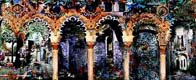
"I
found myself increasingly in tune with the echoes of the past."
Cynthia
Beth Rabin
List
of Exhibitions
 |
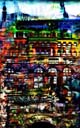 "My
work is an investigation of the threads of cultural memory which I feel
both from my own visual experiences, and through that mysterious transmission
of sensibility which comes from some place beyond the individual. I am
interested in how cultural traditions collide and merge, and how this is
embedded in all of us. New technology has expanded my visual vocabulary,
and all of my work, both video and still imagery, is now produced through
the computer.
"My
work is an investigation of the threads of cultural memory which I feel
both from my own visual experiences, and through that mysterious transmission
of sensibility which comes from some place beyond the individual. I am
interested in how cultural traditions collide and merge, and how this is
embedded in all of us. New technology has expanded my visual vocabulary,
and all of my work, both video and still imagery, is now produced through
the computer. 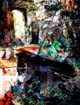 These
images grow from the affinity between my life as a contemporary American,
and what I regard as my heritage, extending to times, places, and philosophies
far from my own experience. Although much of my work focuses on Eastern
European Jewish culture, many other cultural legacies have touched my work
as well.
These
images grow from the affinity between my life as a contemporary American,
and what I regard as my heritage, extending to times, places, and philosophies
far from my own experience. Although much of my work focuses on Eastern
European Jewish culture, many other cultural legacies have touched my work
as well.
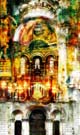 As
a younger artist, I believed in the power of formal visual language to
communicate. Under the influence of American Abstract Expressionism, I
wanted to believe that the play of color against texture could reveal thoughts
and feelings. It was the search for a formal structure to contain my expressionist
gestures that led me to investigate Hebrew manuscripts as a structural
model, after years of looking to Persian manuscripts and other less common
sources.
As
a younger artist, I believed in the power of formal visual language to
communicate. Under the influence of American Abstract Expressionism, I
wanted to believe that the play of color against texture could reveal thoughts
and feelings. It was the search for a formal structure to contain my expressionist
gestures that led me to investigate Hebrew manuscripts as a structural
model, after years of looking to Persian manuscripts and other less common
sources.
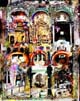 My
introduction to digital media came early, before the age of easy and effective
scanning, but as soon as scanning was readily available I incorporated
it into my imagery. Because of the strong use of architectural motifs in
many Hebrew manuscripts, this led me naturally to move my imagery into
references to specific places. As I traveled to photograph sites for my
work, seeking places that spoke to timeless links through generations,
I found myself increasingly in tune with the echoes of the past. This is
the spiritual side of my work, and the search to go beyond my own moment
in time has become the driving force in my work."
My
introduction to digital media came early, before the age of easy and effective
scanning, but as soon as scanning was readily available I incorporated
it into my imagery. Because of the strong use of architectural motifs in
many Hebrew manuscripts, this led me naturally to move my imagery into
references to specific places. As I traveled to photograph sites for my
work, seeking places that spoke to timeless links through generations,
I found myself increasingly in tune with the echoes of the past. This is
the spiritual side of my work, and the search to go beyond my own moment
in time has become the driving force in my work."